
Keep Running
A fast-paced fable – written 12 years ago and rediscovered

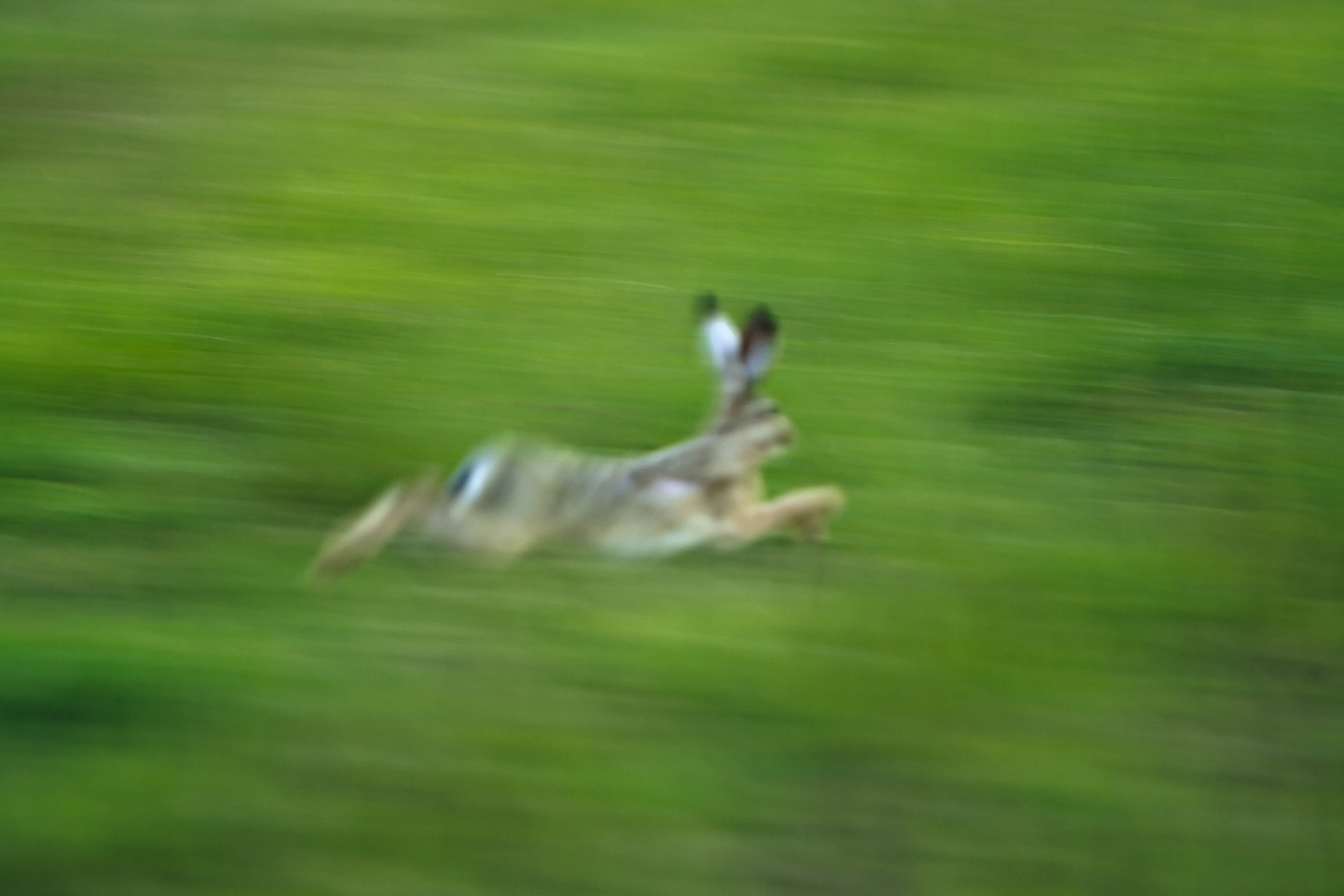
He felt certain that one wrong hop and he’d be dead. The men were weak-legged but desperate. The children were gaunt but everywhere. The dogs were rawboned but their teeth were sharp as ever. So he scampered over the cobblestones in search of a safe place.
His decision to scavenge the town for food was a mistake – but he hadn’t eaten for days and, by the looks of it, neither had the villagers that now pursued him. The grain fields where he often made his home had withered and burned. The gardens were ruined and the creek beds dry; he hadn’t even seen another animal for as long as he could remember.
But he knew too many thoughts would get him killed, so he kept running – between legs, under carts, through tight spaces and around corners. The crowd grew bigger as his strides fell shorter. Feeling a hand graze his tail, he bolted straight ahead, making one last best effort.
Stairs rose beneath him as he bounded toward an open door. Thrown rocks whizzed by his ears. His pursuers screamed angrily as he crossed the threshold, and then their cries began to subside as he scrambled down a darkened hallway.
Soon, voices swelled again, but lower and calmer. He was in a great stone room with flickering candles. Dozens of people sat on wooden benches, their hands clasped together, eyes closed and their heads held down.
No one could see him, but he knew he’d better hide just the same. He spied a large, heavy table near the front of the room and dashed under it, but soon the silence and safety were broken.
The people suddenly raised their heads, and then a set of hollow eyes met his.
“Rabbit!” an ashen woman yelled. Then all eyes were on him and voices pitched in fury.
“Blasphemy! Kill it! It’s sent from the devil himself,” came the cacophony as many parishioners got up from their seats and advanced toward him.
“Silence! And sit down!” a voice boomed from somewhere behind him. The people obeyed. Heavy footfalls were coming his way, slowly but surely. They sounded perilous, but his only other choice was to run back outside – and he knew what that would mean.
The footsteps stopped. He saw the worn black boots they belonged to. And, a moment later, a round face peered under the table and smiled at him.
“Hello,” said the man, who wore a black robe and a shiny silver necklace with two crossed lines. “Don’t worry; I’ll take care of this.”
The face disappeared and, a moment later, the thunderous voice returned.
“This small creature is not only our guest, but a symbol of the sacrifice we celebrate on this day above all others,” the man explained in a more subdued tone. “Its whiteness signifies the purity of the one who died for us. And it came here freely, in spite of the harm that surrounds it, even now.”
“But we are starving,” argued a tall man with a pointed chin, standing in the front row. “The poorest among us have already perished. My children were too feeble to leave their beds this morning. Yet we are faithful. That rabbit would easily make a stew to feed us all for at least this day.”
“And Jesus fed the poor, he did,” a wild-eyed woman exclaimed. “Five thousand of them, and we’re not nearly that.”
“But Jesus provided loaves and fish,” the round-faced man instructed.
“Fish are animals,” begged a woman with a baby in her arms, as many around her agreed.
“But those fish were already dead,” said the black-clad man. “This is a living thing who has sought refuge here. It is sacred.”
“There are no rabbits in Jerusalem!” the pointy-chinned man debated, and the desperate chorus grew louder.
“Perhaps not, but there are hares,” the round-faced man retorted. “I have seen them. This, I am sure, is a hare.
“And there’s something holy about hares,” the black-clad man lectured. “Just before the time of our Savior’s death, he spent much time in the Garden of Gethsemane. There he met and befriended a small creature much like this.
“When Jesus was killed and placed in the tomb,” he continued, “the hare patiently waited. When our Lord arose on Easter morning, he returned to the garden and found his faithful friend.
“That concludes our lesson for today,” he declaimed. “And you shall not leave empty-handed. I have something for each of you as you depart today.”
With that, the round-faced man walked slowly and solemnly down the aisle toward the great wooden doors. The rabbit followed closely at his protector’s heels.
The priest opened a cabinet and pulled out a basket of red-stained eggs. As his parishioners filed out, sadness and malice in their eyes, he handed each person one egg and the same blessing:
“This is a token of bloodshed and new beginnings. May it nourish your soul as well as your body.”
The crowd continued raging outside. When the last person had received her egg –there was just enough for everyone – the priest pushed the great doors closed and heaved an enormous sigh.
The rabbit hopped into the basket. The priest laughed kindly, bent down and gently picked it up as the small creature nestled in. Together, they went back up the aisle and through a small door in a sidewall into the priest’s chambers.
Right away, the rabbit smelled food, and plenty of it. The priest set the basket down on a hard surface, closed the small door and lit several candles to illuminate the darkness. And there, on a polished table of dark wood, were fresh vegetables, cured meats and bread.
The rabbit jumped from the basket and scurried toward a cabbage.
“I know, my friend,” the round-faced priest intoned. “I have so much while my flock suffers. But I am the representative of Christ in this place. Without me, not only lives are lost, but souls. So yes, nourish your body and then rest.”
He did just that – first cabbage, then carrot and finally some spinach. When he’d eaten his fill, he slothfully crawled back into the basket and went to sleep.
When the rabbit awoke, he was in another room, dimly lit with just one flickering candle. He was still in the basket, which was situated on the floor beside a small wooden bed. By the sound of the snores, the priest was deeply asleep. There was a bit of cabbage and spinach on a small plate nearby.
Just as he was about to hop out for supper, the rabbit heard a creaking noise outside the tiny room, then the sound of footsteps on flagstone. They were coming closer; he stayed still. Someone was whispering just outside the door, and then they burst in: three or four people, their faces cloaked in shadow but their intent clear as day.
The rabbit crouched in the basket, trying to make himself as small and unnoticeable as possible – but the people rushed past him and straight at the priest. The round-faced man let out a momentary shriek, which was quickly muffled. The bed shook with struggling, making the posts thud on the stone floor. There was a slash of metal, like the flash of wheat threshed in the grain field, and the rabbit felt something warm upon him.
Even in the half-light, it was easy to see: red blood on white fur. And then, not a minute later, they had found him: stained hands reached for the basket. The rabbit had never screamed before, but tried now, with gruesome fingers drawing nearer.
And he woke up again – not in harm’s way, but in a green pasture under warm sunlight. Not in a basket, but in a tuft of clover. There was yelling nearby, but it was cheerful, not murderous. He lifted his head, turned his eyes and located the commotion.
A tortoise was a few lumbering steps from crossing a brightly colored ribbon. It was dragging itself across the uneven ground as a vast crowd roared with anticipation.
Suddenly, the hare remembered everything – and he ran.